Turtles are reptiles and records show their existence during the days of the dinosaurs 200 million years ago.
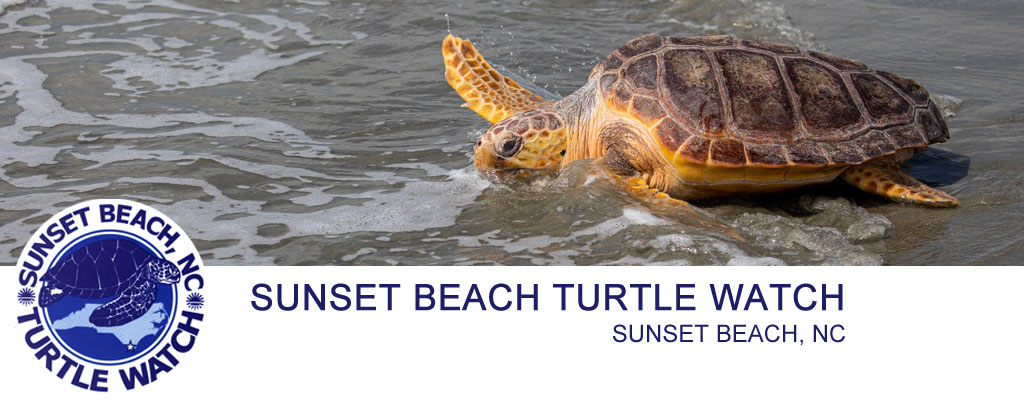
Loggerhead turtles nest in the Carolinas but other sea turtles feed in our waters. They are called Loggerheads because they have the largest head of all sea turtles. They can lay up to 7 nests in one season and usually nest every two years.
Nesting season begins on Brunswick County Beaches in early May thru August. Baby turtles begin hatching in late July and continue through October.
Overdevelopment of beaches limits nesting sites for all sea turtles.
Mortality rates for turtle eggs are high due to predation by ghost crabs, raccoons, & foxes. Some nests are laid to close to the tide line and if not relocated will be lost.
High mortality rates for hatchlings, juveniles and adult turtles are commonly due to predation by sharks, birds, fish, fishing gear(long line), ingestion of marine debris, boat strikes, trash on beaches and pollution.
Only one hatchling in a thousand make it to adulthood (15-25 yrs) They can live to be over 100 yrs old.
Loggerheads use their powerful jaw to crush their food. They most often eat clams, jelly fish, squid, crustaceans such as crabs and spiny lobsters. Most of the nesting takes place in the evening or early morning from May through August. Darkness serves as added protection for nests as well as the hatchlings. Once a nest is laid it takes 55 to 90 days for the hatchlings to emerge.
Hatchlings emerge from their nests and are drawn to light (moonlight and phosphorescence from the ocean). Street lights, house, motel/ hotel lights may cause them to become victims of ghost crabs, sea gulls and the heat of the sun(if they emerge in daylight). Hatchlings swim to the gulf stream and eat the sargassum sea weed which they also use for shelter from predators. They also eat baby shrimp and jellyfish. Hatchlings will return to the same beach where they were born to nest if they make it to adulthood. Remember only 1 out of 1,000 survive to adulthood.
A sea turtle rescue center in North Carolina cares for and rehabilitates injured sea turtles, and returns them to the ocean amid cheering crowds. Sea turtles are resilient, but they are slow to recover. So the Karen Beasley Sea Turtle Rescue and Rehabilitation Center spends a lot of time and effort to help save loggerhead and other Atlantic Ocean turtles.
Click HERE to view "Crowds Cheer as Sea Turtles Return to the Sea | National Geographic"
The mission of the Karen Beasley Sea Turtle Rescue and Rehabilitation Center is the conservation and preservation of all species of marine turtles, both in the water and on the beach. We accomplish this through the rescue, care, and release of sick and injured sea turtles, public education regarding the plight of sea turtles and the threat of their extinction, and learning opportunities for students of biology, wildlife conservation, and veterinary medicine from around the world. A nonprofit organization, we view our work as a privilege and are honored to work with these magnificent creatures.
Amazing Sea Turtle Rescue - North Carolina's Sea Turtle Hospital - CLICK TO VIEW VIDEO - The Karen Beasley Sea Turtle Rescue and Rehabilitation Center is located in Surf City, North Carolina. Since their opening in the mid-90s, the hospital has released over one thousand sea turtles back to the ocean.
North Carolina Sea Turtle Project - run by the NC Wildlife Resources Commission's Division of Wildlife Management, is committed to monitoring NC's sea turtle population. This project would not be possible without the help of hundreds of volunteers, as well as many organizations and agencies. This site serves to facilitate information exchange among Project participants and Project biologists with the NCWRC, as well as provide information on NC's sea turtles to the general public.
SC Marine Turtle Conservation - The SCDNR Marine Turtle Conservation Program is responsible for managing and protecting sea turtles in South Carolina.
Defenders of Wildlife - Sea turtles are one of the Earth's most ancient creatures. The seven species that can be found today have been around for 120 million years, that's longer than the dinosaurs.
Sea Turtle Conservancy - Information About Sea Turtles, Their Habitats and Threats to Their Survival
NOAA Fisheries - Office of Protected Resources - "For most of the wild things on Earth, the future must depend upon the conscience of mankind." - Dr. Archie Carr, father of modern marine turtle biology and conservation
SeaTurtle.org - Organize the world's sea turtle information and make it universally accessible and useful.
Archie Carr Center for Sea Turtle Research - Only through research can we hope to obtain the information necessary to counteract these threats and ensure the survival of these magnificent creatures.
One More Generation - Please help us ensure all endangered species survive at least One More Generation... and beyond.
Smart Yards by North Carolina Coastal Federation - Why have a smart yard guide? Because you care about keeping our creeks, rivers and sounds healthy for fishing and swimming. This guide includes a simple Do-It-Yourself (DIY) Smart Yard projects to reduce stormwater and improve the health of our coastal waters.
Click HERE to view the Sunset Beach Turtle Patrol Presentation (PPT Format).
THINGS TO DO NEAR SUNSET BEACH
Town of Sunset Beach - click HERE, the smallest of the Brunswick Beaches, and what we like to think of as a coastal paradise.
If you are a regular visitor, you already know about our beautiful beach and the natural resources we enjoy. Youre familiar with our family-friendly approach and the friendliness of our residents. And certainly, you've already noticed the biggest change in Sunset Beach's history -- our historic pontoon swing bridge now sits on land and the new Mannon C. Gore Bridge provides a safe and pleasant ride to our Island.
Sunset Beach Fishing Pier - Click HERE for more information on the Pier at Sunset Beach and to get the daily fishing reports.
Old Bridge Preservation Society - Click HERE for more information.
Visit Sunset Beach - Click HERE for more information.
Sunset Beach Waterfront Market - Click HERE for more information.
NC Brunswick Islands - Sunset Beach, NC - Click HERE for more information.
Kindred Spirit Mailbox - Click HERE CBS News - For anyone who's ever felt they just had to get something off their chest, Chip Reid may have found the perfect place to do it. On a remote beach on the coast of North Carolina stands a solitary mailbox. Who put it there and why has long been a mystery -- until now.
The Ocean Isle Museum Foundation, Inc. (OIMF) is a non-profit organization with two facilities, the Museum of Coastal Carolina and Ingram Planetarium. It shall be the mission of the Ocean Isle Museum Foundation, Inc. to stimulate the general public's interest in and understanding of the natural science, environment, and cultural history of the coastal region of the Carolinas, as well as a broader understanding of our earth, our solar system, and our universe, by providing quality educational features for both the public and school students through activities and exhibits.